If there’s one tool that has stood the test of time, it’s the moving average indicator. Simple, versatile, and beginner-friendly, it helps traders spot trends, identify potential reversals, and generate trading signals without cluttering the chart.
Whether you’re new to trading or looking to sharpen your technical analysis skills, understanding moving averages can give you a solid edge. Let’s break it down.
Article content
- 1 What Is a Moving Average?
- 2 Why Moving Averages Are Important in Forex Trading
- 3 Types of Moving Averages
- 4 How Moving Averages Help Identify Trends
- 5 Moving Average Trading Strategies
- 6 How to Use Moving Averages as Support and Resistance
- 7 Best Moving Average Settings for Forex Trading
- 8 Common Mistakes When Using Moving Averages
- 9 Frequently Asked Questions
- 10 Conclusion
What Is a Moving Average?

A moving average is a technical indicator that calculates the average price of a currency pair over a specific period. Instead of showing every market fluctuation, it smooths out price action and highlights the bigger picture.
Think of it as removing the noise so you can hear the music. The primary purpose of a moving average is price smoothing, making it easier to identify the market’s direction.
Because it relies on historical data, a moving average is considered a lagging Forex indicator that traders use to confirm trends rather than predict them.
Why Moving Averages Are Important in Forex Trading
Forex markets move fast. Prices can change direction in the blink of an eye. That’s where Forex moving averages come in handy. They help traders:
- Identify market trends
- Filter out short-term volatility
- Generate trading signals
- Find potential entry and exit points
- Confirm other technical analysis indicators
- Act as a support and resistance
In short, moving averages help traders avoid chasing every market move and focus on the trend that matters.
Types of Moving Averages
Not all moving averages are created equal. Each type has its own strengths and weaknesses. Some react quickly to price changes and generate earlier signals, while others focus on smoothing out market noise and highlighting the broader trend. Choosing the right moving average depends on your trading style, timeframe, and overall strategy.
Simple Moving Average (SMA)
The simple moving average (SMA) calculates the average closing price over a selected period. Because every price is treated equally, the SMA helps filter out market noise and makes trends easier to spot. It doesn’t react as quickly as some other moving averages, but that’s exactly why many traders use it to get a clearer view of the overall market direction.
Exponential Moving Average (EMA)
The exponential moving average (EMA) gives more weight to recent prices. As a result, EMA can spot potential trend shifts earlier than SMA and is often favored by short-term and active traders.
The trade-off is that its faster reaction can sometimes pick up market noise and generate false signals. Even so, EMA remains one of the most popular tools in trading because it helps traders stay closer to current price action.
Weighted Moving Average (WMA)
A weighted moving average assigns different weights to price data, giving the highest importance to the most recent prices. Because it reacts quickly to market changes, WMA can help traders spot potential trend shifts earlier.
However, that speed comes with a downside. The indicator is more sensitive to short-term price fluctuations and may generate false signals in choppy markets. While WMA is less popular than SMA or EMA, some traders use it when they want a more responsive view of current market momentum.

How Moving Averages Help Identify Trends
One of the biggest advantages of moving averages is trend identification in Forex:
- A rising moving average generally signals an uptrend
- A falling moving average often indicates a downtrend
When the price stays above the moving average, buyers are usually in control. When the price remains below it, sellers often dominate the market. It’s not rocket science, but it works surprisingly well.
Moving Average Trading Strategies
There are dozens of ways to trade with moving averages. Here are three of the most popular approaches.
Moving Average Crossover Strategy (Golden Cross & Death Cross)

Think of this strategy as a simple way to tell who’s in the driver’s seat. When a shorter moving average, like the 50-day MA, crosses above the 200-day MA, it’s called a Golden Cross and suggests buyers are taking control.
When it crosses below, a Death Cross appears, signaling sellers may have the upper hand. It’s easy to spot and works well when markets are trending, but it can be a step behind the action when prices are moving sideways.
Moving Average Ribbon Strategy
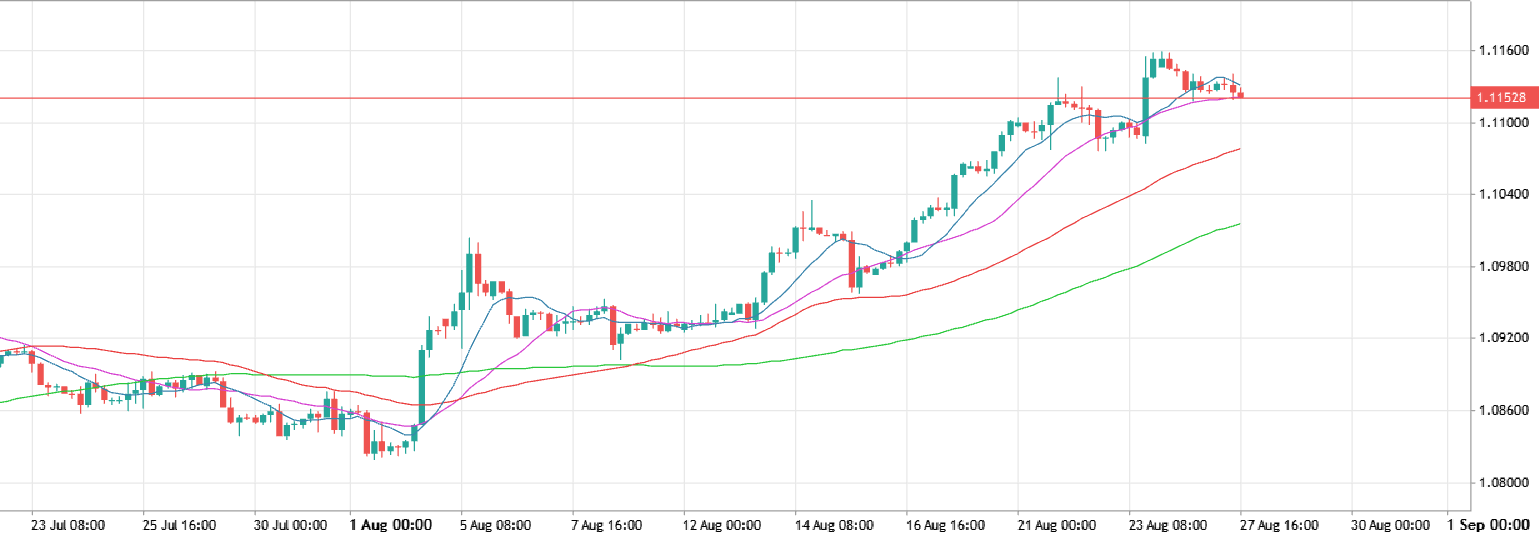
A Moving Average Ribbon uses several moving averages layered on top of each other to show whether a trend has legs. When the lines fan out, the market is picking up steam and the trend is gaining traction.
When they bunch together, it can be a sign that momentum is running out of gas. Many traders like this approach because one quick glance can tell you whether a trend is strong or starting to lose its edge.
Moving Average Envelope Strategy

The Envelope strategy wraps a moving average with upper and lower bands, creating a kind of price playground. When the market stretches toward the upper band, it may be getting ahead of itself and due for a breather.
When it drops to the lower band, buyers may see an opportunity to step back in. It’s a handy tool for spotting potential turning points.
How to Use Moving Averages as Support and Resistance
Many traders use moving averages as dynamic support and resistance levels. Unlike horizontal lines, moving averages move with the market. For example:
- During an uptrend, the 50 EMA may act as support
- During a downtrend, the same EMA may become resistance
The key is not to treat the moving average as an exact line. Think of it as a zone rather than a brick wall.
Best Moving Average Settings for Forex Trading
One of the most popular questions is: what is the best moving average period? The truth is, there is no magic number. Common settings include:
|
Trading Style |
Popular Moving Averages |
| Scalping | 5 EMA, 10 EMA |
| Day Trading | 20 EMA, 50 EMA |
| Swing Trading | 50 SMA, 100 SMA |
| Position Trading | 100 SMA, 200 SMA |
The best settings depend on your strategy, timeframe, and risk tolerance.
Common Mistakes When Using Moving Averages
Many traders make the same mistakes over and over again. Avoid these common pitfalls:
- Using only one indicator
- Ignoring market conditions
- Choosing periods without testing
- Trading every crossover signal
- Forgetting risk management
Don’t put all your eggs in one basket. A moving average should support your analysis, not replace it.
Frequently Asked Questions
Which moving average is best for forex trading?
There is no single best option. Many Forex traders use the 20 EMA, 50 EMA, and 200 SMA because they work well across different market conditions.
Is EMA better than SMA?
The answer depends on your trading style. EMA reacts faster to price changes, while SMA provides smoother trend signals.
Can moving averages predict market direction?
Not exactly. Since they are based on historical prices, moving averages confirm trends rather than predict future market direction.
Conclusion
Learning how to use moving averages in Forex trading is one of the best starting points for any trader. These indicators help identify trends, provide support and resistance levels, and generate valuable trading signals. Experiment with different settings, test various strategies, and find what fits your trading style. In trading, consistency beats complexity every time.